
How Do I Remove Scratches From Stainless Steel Sink?
Scratches are common on Stainless Steel Sinks because cookware, knives, cutlery, cleaning tools, and hard food particles repeatedly contact the surface.
Some scratches affect only the appearance and gradually become less noticeable. Deep marks may cut into the metal and cannot be removed completely without altering the surrounding finish.
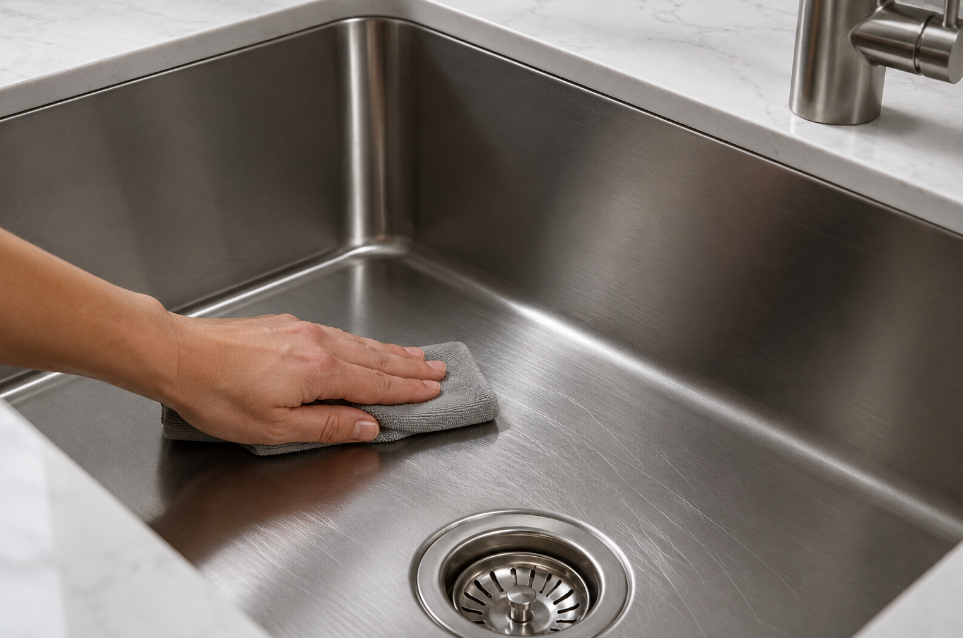
Inspect the Scratch Before Treatment
Wash and dry the sink before deciding how to treat the damaged area.
Grease, mineral residue, or transferred metal marks can make a light scratch look deeper than it actually is.
Identify a Light Surface Mark
A light scratch is usually difficult to feel with a fingernail.
It may be caused by sliding utensils, metal pans, abrasive particles, or unsuitable cleaning pads. Light marks can sometimes be blended into the existing brushed finish.
Recognize a Deep Scratch
A deep scratch can be felt clearly and may have a sharp or raised edge.
Aggressive sanding can create an uneven depression or a bright polished patch. Professional refinishing may be more appropriate for serious damage.
Clean the Sink Thoroughly
Use warm water, neutral detergent, and a soft sponge to remove dirt and grease.
Rinse the surface and dry it completely. Attempting to polish a dirty sink may drag hard particles across the steel and create additional scratches.
Find the Direction of the Grain
Brushed stainless steel normally has fine parallel lines running in one direction.
Any cleaning or polishing movement should follow these lines.
Avoid Circular Scrubbing
Circular rubbing may create visible swirls and cloudy areas.
Moving across the grain can also make the treated area look different from the surrounding sink.
Test a Hidden Area
Test the planned cleaner or polishing product near a rear corner before applying it to the main bowl.
Some sinks use PVD colors, anti-fingerprint coatings, or decorative treatments that should not be polished with abrasive materials.
Blend Light Scratches Carefully
Apply a small amount of stainless steel cleaner or an approved polishing compound to a soft cloth.
Rub gently along the grain using light and consistent pressure.
Treat the Surrounding Area
Do not polish only the narrow scratch line.
Blend a slightly wider area so that the result follows the surrounding grain and reflection. Wipe away the product and inspect the surface before repeating.
Several controlled passes are safer than one heavy treatment.
Avoid Common Mistakes
Do not use knives, metal scrapers, coarse steel wool, or random grades of sandpaper.
Avoid highly abrasive powders unless the sink manufacturer confirms that they are suitable for the finish.
Know When to Stop
A deep scratch may be reduced but not completely removed.
Continuing to polish the area can create more visible damage than the original mark. Professional repair or replacement may be the better solution when the surface has been deeply cut.
Prevent New Scratches
Use a removable bottom grid when washing heavy pots and cookware.
Rinse sand, broken ceramic particles, and other hard debris from the bowl before moving items across the surface. Avoid leaving carbon-steel tools or wet metal fragments inside the sink.
Why Finish Consistency Matters on an Undermount Sink
An Undermount Stainless Steel Sink is installed beneath the countertop, creating a continuous work surface around the bowl.
Because the rim is concealed, the internal bowl and surface finish become more visually prominent. Consistent grain direction and controlled polishing help maintain a uniform appearance across the side walls, corners, base, and drain area.
Our Manufacturing and Surface-Control Capability
Our factory supports stainless steel sink production from product design and sheet processing through forming, welding, finishing, inspection, and packaging.
We can customize bowl dimensions, corner radii, steel thickness, drainage positions, sound-reduction components, surface treatments, and accessory combinations for brands, distributors, contractors, and project buyers.
Develop an Undermount Stainless Steel Sink
Sourcing sinks for stone countertops, apartments, hotels, kitchen brands, or distribution channels?
Provide the cabinet width, bowl dimensions, corner radius, drain position, steel thickness, finish reference, accessories, packaging, and order quantity. We will prepare an Undermount Stainless Steel Sink solution for sample confirmation.