
How Deep Are Kitchen Cabinets?
Kitchen cabinet depth plays a crucial role in both storage efficiency and overall kitchen ergonomics. When designing or upgrading a kitchen, many homeowners focus on height and layout, yet depth determines how comfortably items can be stored, how appliances fit, and how easily people move within the cooking space. Understanding standard depths, customized dimensions, and material choices helps ensure the kitchen is functional, well-organized, and aesthetically balanced. Modern stainless-steel kitchen systems—such as the stainless steel kitchen cabinet from JOINT POWER—offer greater structural flexibility, allowing precise depth customization while maintaining durability and hygiene.
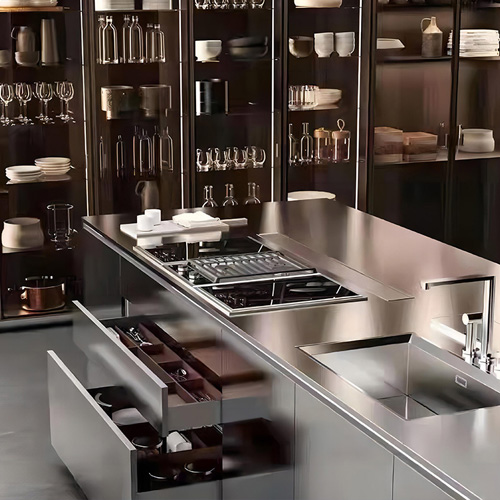
Standard and Custom Depths of kitchen cabinets
Kitchen cabinets come in various depth options, each designed for specific functional needs. While many homes follow conventional measurements, customized depth adjustments are increasingly common, especially in modern stainless-steel cabinet systems that allow more structural precision.
Base Cabinet Depth
Base cabinets are the workhorses of the kitchen. In most homes, they are built around a standard depth of 24 inches (about 610 mm). This depth is widely used because it accommodates typical countertop dimensions, supports cooking appliances, and provides enough space for large cookware.
However, depth can vary depending on user needs. Some modern kitchens extend base cabinets to 26 inches to gain more storage volume and deeper countertops. In contrast, compact kitchens sometimes use 22-inch depths to create more floor space. Stainless-steel base cabinets offer even greater adaptability, remaining stable and warp-free regardless of depth adjustments.
Wall Cabinet Depth
Wall cabinets typically have a depth between 12 and 14 inches. This dimension ensures head clearance while standing at the counter and leaves enough room for plates, cups, spices, and daily items. A 12-inch depth is the most common, while 14-inch wall cabinets are often selected for kitchens that require additional overhead storage.
Designers tend to avoid deeper wall cabinets because excessive depth obstructs visibility and creates difficulty reaching items. With stainless-steel structures, even lightweight wall cabinets maintain high rigidity at various depths.
Tall Cabinet Depth
Tall cabinets—also known as pantry cabinets—typically range from 18 to 24 inches deep. These cabinets store large quantities of food, appliances, and cleaning products. The deeper the cabinet, the more shelving configuration options become available.
Pantry cabinets built using stainless-steel internal frames benefit from improved weight support, allowing them to hold heavier loads without sagging or internal deformation.
Appliance-Integrated Cabinet Depth
Cabinets designed to house appliances such as ovens, dishwashers, and refrigerators must follow exact depth specifications. Most built-in appliances are designed around the standard 24-inch cabinet depth, but some models require 25 to 28 inches including ventilation clearance.
Using a stainless-steel cabinet system makes it easier to provide accurate tolerances because metal structures maintain their shape better than wood or MDF when exposed to heat, humidity, or long-term weight.
Depth Differences Based on Kitchen Style
Different kitchen styles influence cabinet depth decisions. Each layout requires careful planning to balance workflow, circulation, and storage.
Linear Kitchens
In single-wall kitchens, deeper base cabinets (such as 25 to 26 inches) create more functional countertop surfaces, compensating for the lack of additional storage walls. Stainless-steel systems offer slim yet sturdy structural frames that make deeper cabinets visually clean.
U-Shaped Kitchens
U-shaped kitchens must maintain enough walking space. This often means keeping base cabinets at standard depth to prevent overcrowding. Wall cabinets may vary depending on appliance placement.
L-Shaped Kitchens
This layout provides flexibility for adjusting cabinet depth. Some homeowners choose deeper base cabinets on one side for large cookware storage, while the other side remains at standard depth to maintain movement flow.
Island Kitchens
Kitchen islands frequently use oversized depths—sometimes 27 to 30 inches—for added storage and seating overhang. Stainless-steel islands are particularly beneficial because of their load-bearing strength and resistance to moisture from sinks or beverage stations.
Cabinet Depth Comparison Table
| Cabinet Type | Typical Depth | Customizable Range | Notes |
|---|---|---|---|
| Base Cabinet | 24 in | 22–26 in | Supports countertops and appliances |
| Wall Cabinet | 12–14 in | 10–16 in | Ensures head clearance |
| Tall Cabinet | 18–24 in | 16–28 in | Varies by pantry storage needs |
| Appliance Cabinet | 24 in | 24–28 in | Depends on appliance specifications |
| Island Cabinet | 27–30 in | 24–32 in | Deeper options for multifunction use |
Stainless-steel cabinet systems allow all these ranges to be customized precisely while maintaining structural integrity.
Common Customer Questions About Kitchen Cabinet Depth
Many homeowners have similar concerns when choosing cabinet depth, particularly when combining different cabinet types in one space. Below are frequent questions and detailed answers.
“Can kitchen cabinets be deeper than standard size?”
Yes. Beyond standard depth, cabinets can be customized for additional storage, larger appliances, or ergonomic preferences. stainless-steel cabinets handle deeper dimensions especially well because the material resists bending, warping, and moisture intrusion.
“Is 24 inches required for base cabinets?”
While it is the most common depth, it is not mandatory. Smaller kitchens may opt for 22 inches to save floor space, while professional cooking areas may choose 26 inches for more workable surface area. The key is balancing comfort, appliance fit, and walkways.
“How do I choose the right depth for wall cabinets?”
The ideal depth depends on the items stored. Plates and bowls fit well in 12-inch cabinets, while 14-inch options accommodate larger serving dishes. Depth should never obstruct countertop workspace or lighting.
“Will customized depth affect countertop installation?”
Countertops are fabricated to match cabinet depth. With stainless-steel cabinets, precision is high because CNC production ensures exact dimensions, making customized countertops easier to fit securely.
“Does deeper cabinetry reduce kitchen walking space?”
Yes, deeper cabinets reduce walkway clearance, so circulation space must be calculated early. For kitchen layouts with high traffic, maintaining standard depth is often practical.
“Is stainless steel better for deep cabinets?”
Stainless steel is one of the best choices for deeper cabinets because:
It does not deform under heavy loads
It resists moisture, ideal near sinks and heat-producing appliances
It supports long spans without internal reinforcement
It maintains a sleek, modern appearance even at extended depths
This is why many high-end homes and commercial kitchens prefer stainless-steel options such as JOINT POWER’s cabinet systems.
“Does deeper storage mean harder access?”
Sometimes yes. Pull-out racks, soft-close drawers, and adjustable shelves help maintain accessibility. Stainless-steel cabinets integrate these features easily due to strong internal structural support.
Summary
Kitchen cabinet depth affects storage space, ergonomics, appliance compatibility, and overall kitchen function. Standard depths—such as 24 inches for base cabinets and 12 inches for wall cabinets—serve most homes well, but customized depths provide tailored solutions for unique layouts. Stainless steel stands out as an ideal material for deep or custom cabinets due to its structural strength, moisture resistance, and precision manufacturing.
With advanced production technologies and decades of craftsmanship, JOINT POWER delivers high-performance stainless-steel kitchen cabinets that support customized depth options without compromising durability or design. By choosing the right depth and material, you ensure your kitchen remains organized, efficient, and beautifully balanced for years to come.